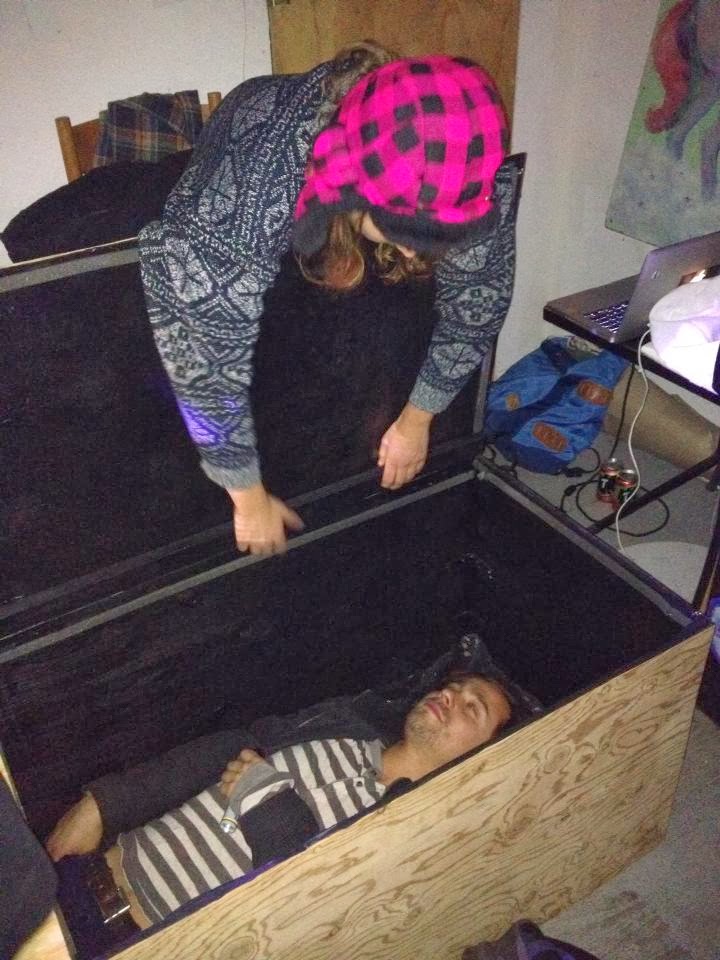
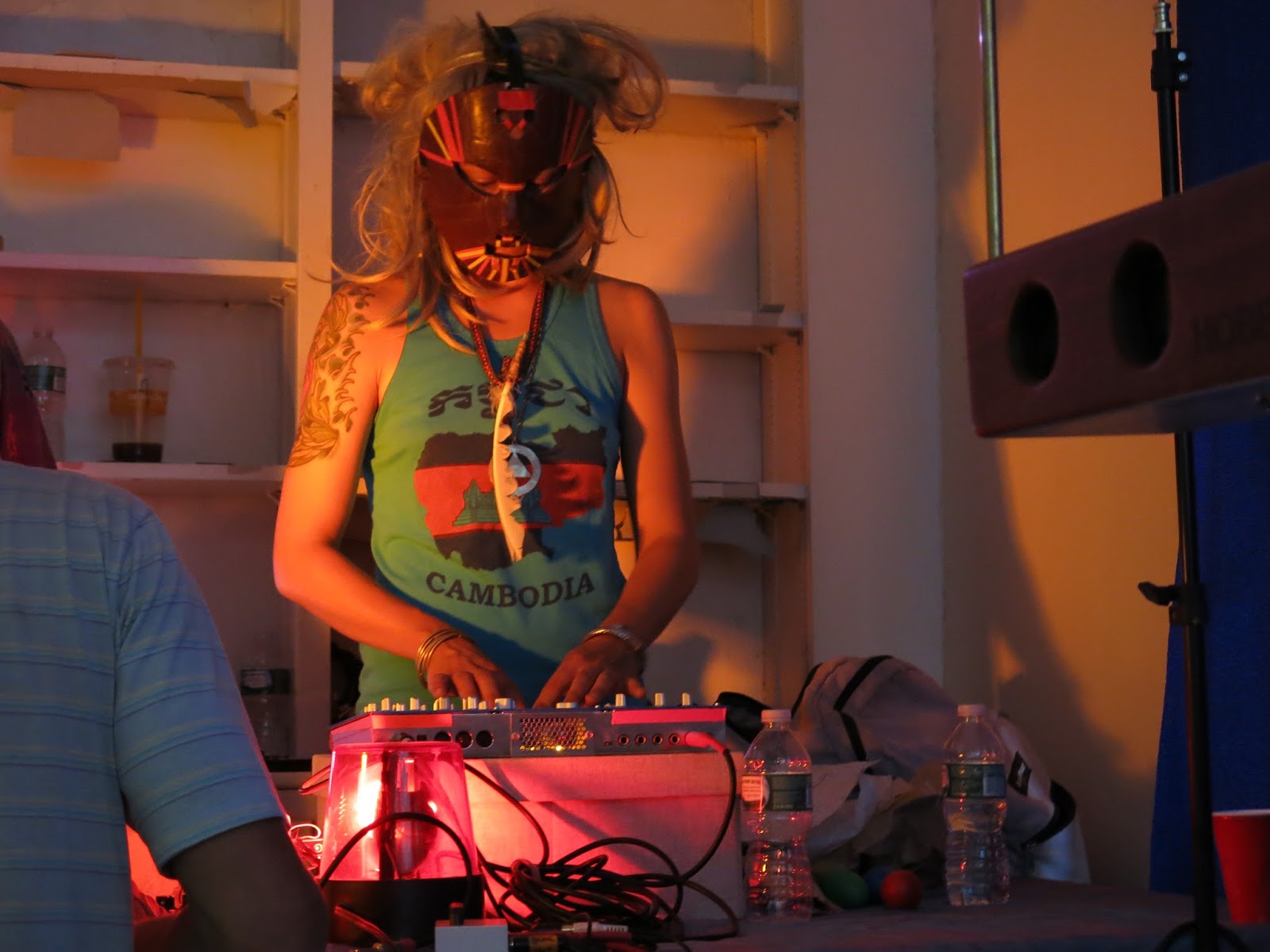
Sound Coffin is an immersive sensorial transformation. Here the participant enters the light proof coffin and begins a journey into the depths of ego and death. Low frequency droning sound waves cascade through the body propelling the self out of the physical and into the infinite space of the etheric plane, connecting you with the unseen forces of life.
Things got too wild for the fair and our power was cut off by the organizers. Apparently the performance was just too much to handle. Does sound and performance have a room in the house of art? Or are they the mistreated stepchildren searching for some loving arms! Above: Geraldo, Dominika, Charlie & Angel
Photos Salpy Semerdjian
Inside the Hunter Gallery at 450 W 41st in Midtown a concrete ouroboros lies in solitude. After the laborious sweat and pours of Elizabeth Tubergen and the many hands and hours of fellow artists and friends, a lonesome monolith begs for a festivity to occur! An orgy of hope and transformation needing the powers and energies of us all to rise up, focus and call the forces to our aid. Then upon convergence we shall smash, splatter and destroy as an offering to the new dawn. A group vision whose only opposition is the self. A gutteral exertion of lambastic actions alchemizing the repugnance and disgust into an evenings delight!
Stairway to Hedon: The Collapse of the American Empire So here is the basics I invite you all to bring your amazing selves, your odes, wishes,
warnings and debaucheries, costumes, characters, attitudes,
temperaments, hearts, hammers and bags of magik. We will all get into,
onto, under and over the slinking stairs. Releasing, realizing and
relating to all that was, is and shall be. This is a collaboration with
us all so anyone willing to shoot video, bring live sound or perform
would be most excellent and necessary. I would love this to be the
meeting of the magik because we are all coming from different groups,
perspectives, stories and lives and to bring that energy into one space,
onto one object, would truly resonate in the most ecstatic of ways! The idea is we will gather for a few hours of wonderment and then
tear the installation down re-igniting its vitality with our corporeal
selves. Travis Braxton, B.J. Dini, Angel Favorite, Sabina Ibarrola, Heather
Acs, Sequinette Jaynesfield, Elizabeth Tubergen, Angela LaSalle,
Margeaux Walter, WildTorus {Mike + Amy}, Marissa Bluestone, Regan
Venezia, Jeff, Salpy Semerdjian, Natalie Agee, Mette Loulou, Jane
Carver, Deanna Viva Garcia, Matt & Mike, Danny if I
missed you let me know so I can fix that please. :) Thanks Everyone for your Energies & Hearts Warmly, Dominika All sounds created by the tools and booms of the fall and mixed by DK
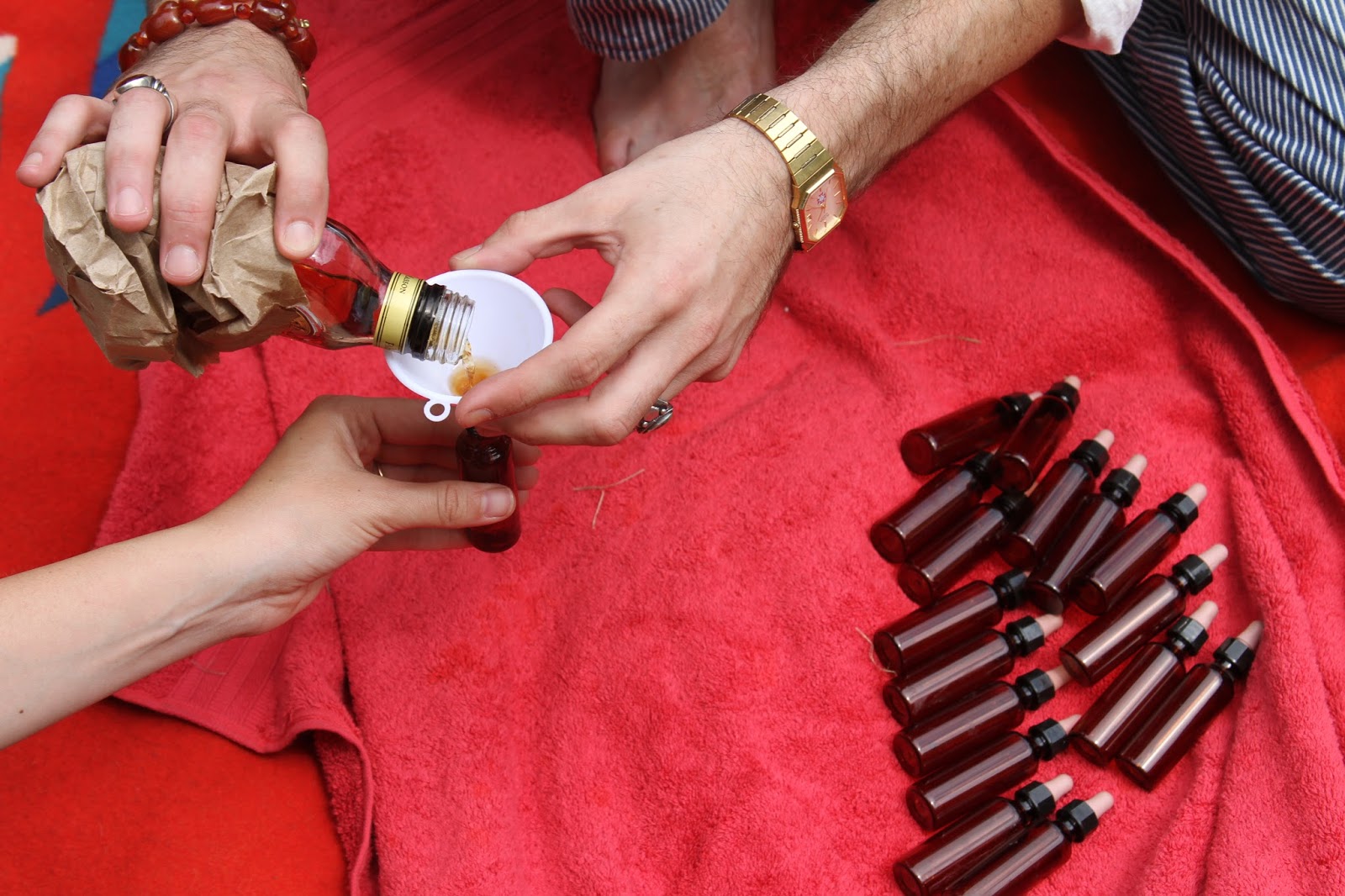
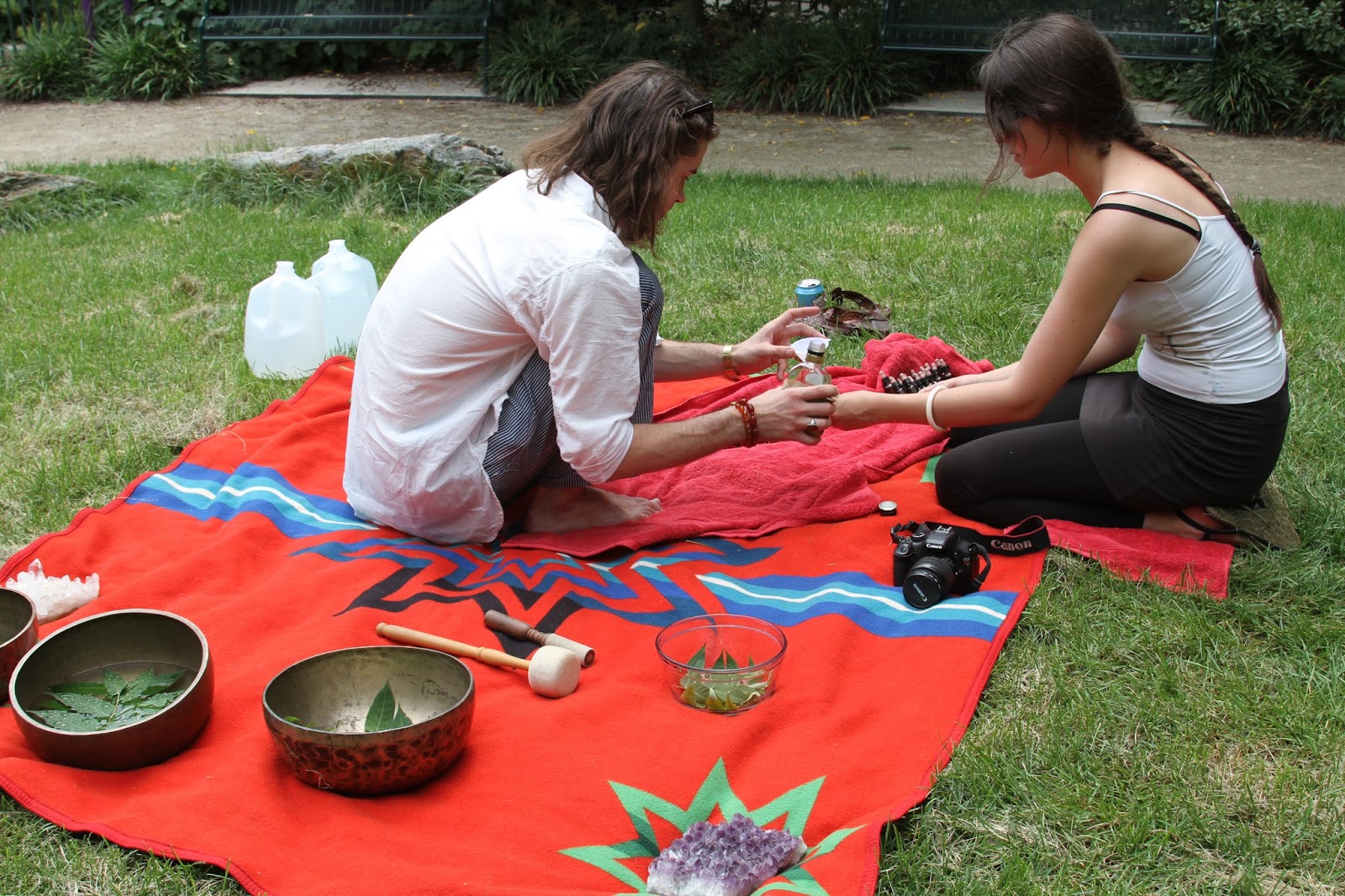
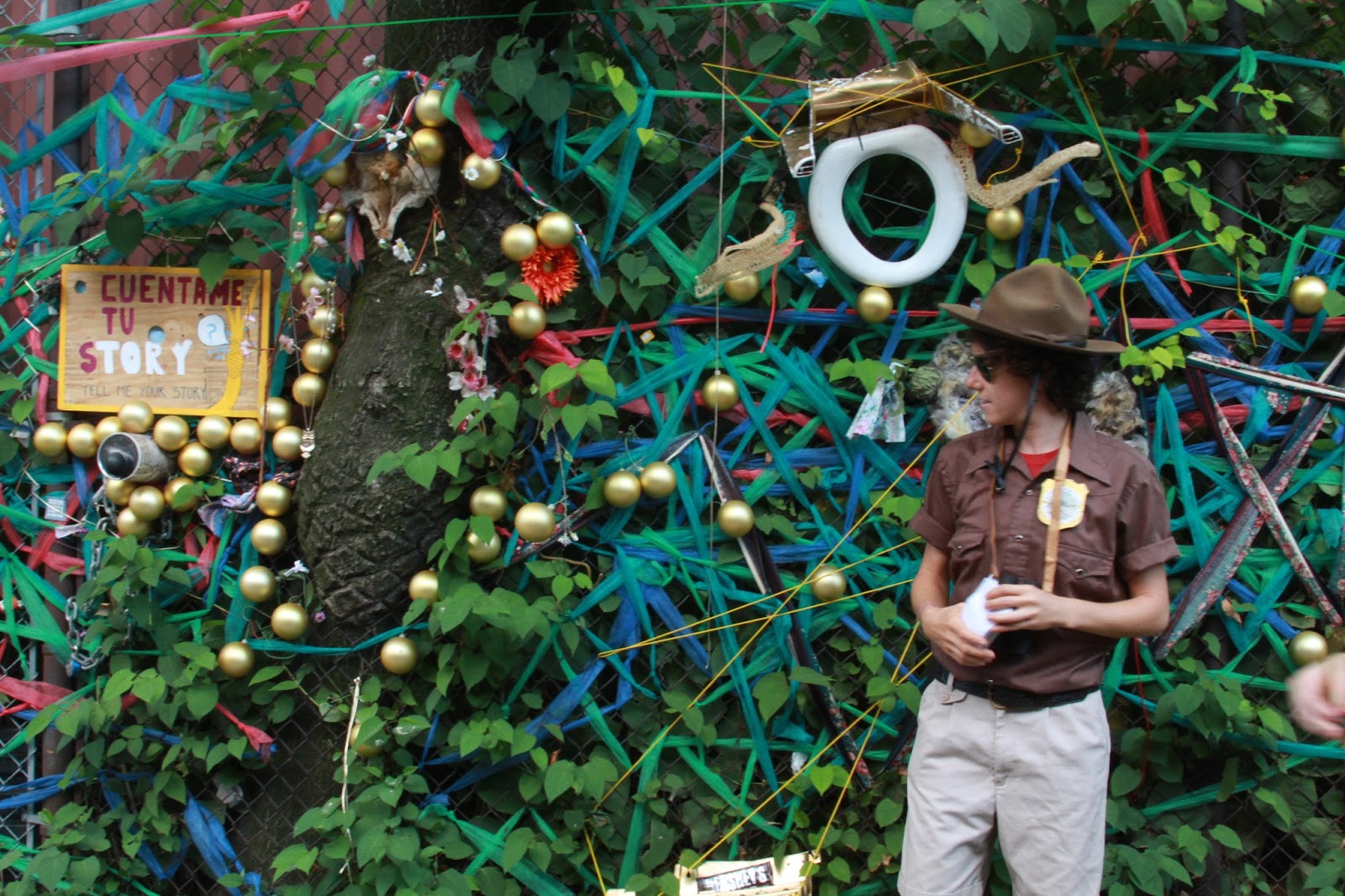
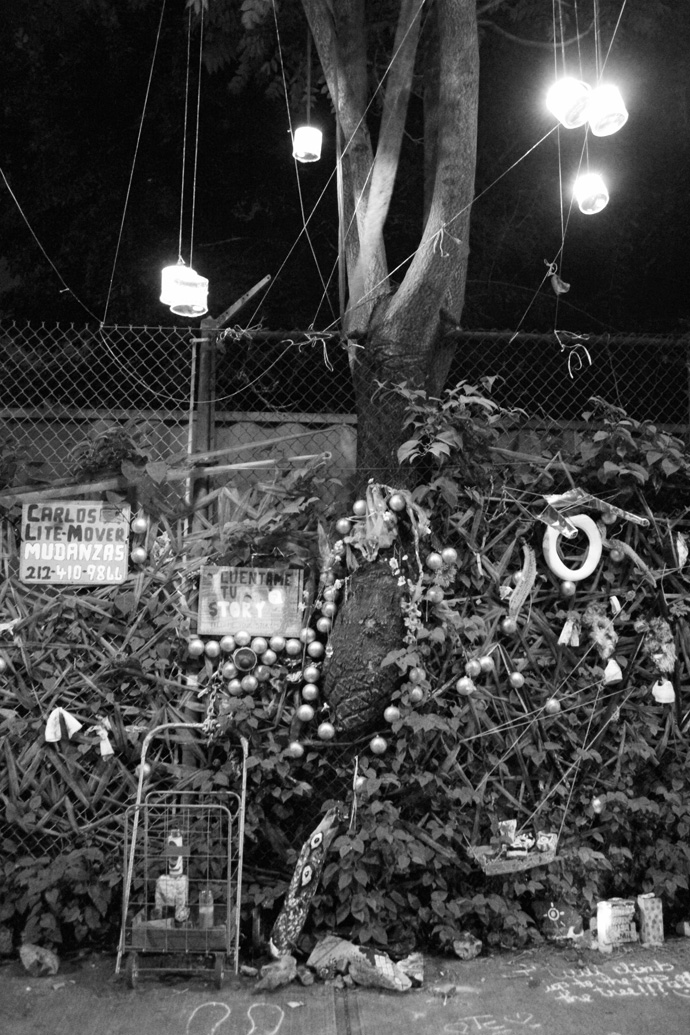
On August 10th we gathered at the 103rd St Park for a sensory exploratorium filled with story-telling delights, myth-making wonders, unraveling the relationships to our surrounding plant friends and the over-arching consciousnesses that intersect us all through space and time. Here, the histories and mysteries of now are highlighted and re-imagined in the periphery, in the space of hybridization. The tree analogue is our origin, as it lies on the borders, urbanized nature merged as one. A delicate balance of forces whispering the potential relationships of our psycho-ecologies. A chance to build our futures instead of having them dictated to us. A place of boundless possibility, growth and cooperation, catalyzed into a rhythmic rhizomatic expansion. With Pete Makela, Maxi Cohen, Lillian Gershon, Patricia Dominguez and Dominika Ksel.
LA BIENAL: FROM HERE WE JUMP / MUSEO DEL BARRIO
A collaboration between Dominika Ksel and Patricia Dominguez
There is one specific tree that has become a hybrid during the years.
It merged into the fence, creating a new morphology between urbanization
and organic growth. It is radiantly impure. This tree will contain a
box with an audio recording unit. The recording device will be slightly
camouflaged in a box. People will be able to access this box from the
periphery of the park, as it is part of the fence. The storytellers can
stand beneath the tree and press record when they are ready to share
personal experiences, love songs, messages to deceased loved ones, dirty
jokes, local gossips, commentaries on current events, weather
predictions, marriage proposals, confessions, forgiveness, offerings,
wishes, desires, frustrations and new myths. The tree will be also
activated as temple, healing center, materia prima for essences and
inspiration for wood cuts, weaving, as cabinet of curiosity and a new
celestial body.
We are re-territorializing the park by activating the periphery with
the installation, changing the park dynamics. This is an inversion of
the panopticon, the non-monument, and a moment where the periphery
absorbs from the center.
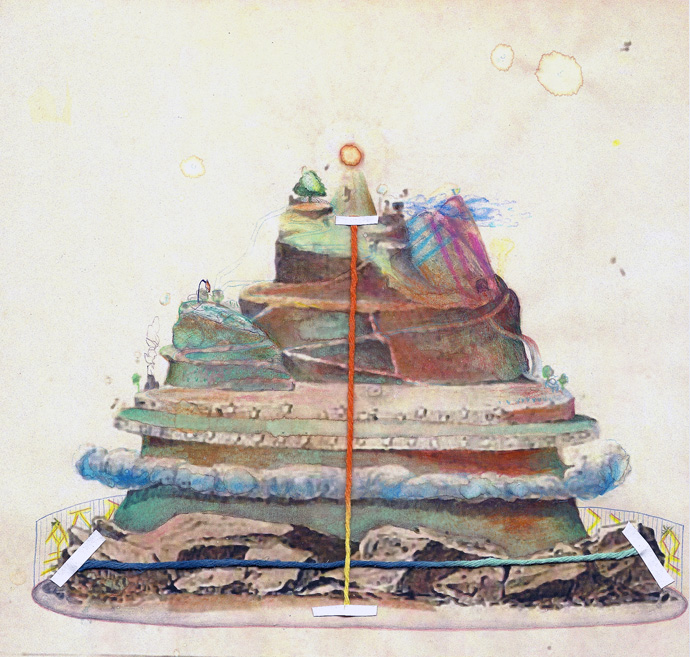
The formal arrangement of the installation refers to esoteric visual
symbolism of the tree standing of the top of a hill; an axis mundi. A
microcosmic version of monumental myths portrayed through a light
hearted – Quixote style setting, pushing the imagination and the
transformative and connective potential of storytelling and myths.
Images of the sleeping Buddha dreaming of enlightenment, a fallen apple
sparking theories of gravity or the search for the sacred Mount
Analogue. Here, we put together a new cosmology. A ritual for recording
the myths and stories in non-traditional ways. A new lore, removing
hierarchies, where every story carries equal weight and voice. There is
no authoritarian narrative in this fractitious and rhizomatic method of
simultaneous (hi)story making.
The tree installation is not temporal, but permeating the environment
and the community over time. Creating a life of its own through new
interpretations, exchanges, transferences and becomings. The recording
unit will be installed from August 1st to September 1st. An oral library
will be put together to give further access to the recordings and will
serve as an ongoing collection of stories for future visual
investigations. There will be several events around the tree involving
other artists too.
As extension of the project we will include some events that will
manifest into printed imagery of the tree, healing essences from its
leaves, new symbols and enactments of rituals that will include several
surrounding institutions such as Mount Sinai Hospital and Casita Maria
After School Program. We will invite to collaborating herbalists,
artists and musicians.
Q+A Rocio Aranda-Alvarado: What is the most important thing about your process that you want people to know?
In my practice, I used naturalistic and
invented operations, in the hope of forming a personal language.
Historically, naturalism has been a language used to colonize and fix
the identities of the territories of the new world. The colonizers named
and classified the specimens that inhabited those territories, helping
to construct ideas of the exotic, and the other that carry a lot of
idealization and misunderstanding. I try to change the genealogies of
those same territories, by using and inverting the same language that
reduced them.
In 2010, I decided to learn the formal
language used to represent specimens. I did a Natural Science and
Botanical Illustration program at the Bronx Botanical Garden, and in
2011, I was a Visiting Artist at the Paleontology Department of the
American Natural History Museum. I learned digital illustration of
fossils and recreations of ancient landscapes through 3D digital
software. I've never believed in Natural Science as the most acute way
of acquiring knowledge about the world, as this discipline studies
nature as nature. I quickly hit a wall, as I wanted to study culture as
natural phenomena too, with all the anthropological, sociological,
ethnological and historical concerns that that intrinsically carries. In
this way, I use methods taken from the Natural Sciences such as
recollection, classification, archaeological excavations, (static)
explorations, archiving and organization but I permeate them with human
subjectivities and social behaviors.
The reference for my invented,
once-removed naturalist methods is the amateur archaeologist, ex hunter
and architect Gonzalo Dominguez, my grandfather. For years, he has
excavated a specific area of the Atacama Desert in Chile. He has
discover mummies, new species of whales, 16 million year old sharks,
indigenous devices and artifacts, old toys, colonial devices left by the
Spanish, carved bones, the most southern colony of green turtles of the
world, old flags, indigenous paintings on the rocks, bullets, and
collect garbage coming from the other side of the ocean.
Along the years, I have seen him
re-arrange his discoveries in cabinets made of fishnets discarded by the
sea in a museum that combines the layered discoveries of that terrain;
The Museum of the Seagulls. It is an archaeological excavation that is
open to time and space. All those objects were found colliding into each
other throughout and beneath the surface of the same place in the
desert. Every new specimen that was found confirmed or disrupted formal
ideas of that specific place, and helped putting together an alternative
history of the place. The terrain acts as a possibility of both
accessing history and re-arranging history at the same time.
He had invented a new genre; he has
webbed and connected indigenous art, popular culture, historical events,
contemporary art, and his own crafts. As Paraguayan anthropologist,
writer and art curator Ticio Escobar said, "When someone modifies images
and concepts of the Other, it is only when it is advantageous to their
own stories. When the appropriation is made with the imagination, it
produces results where new and old forms become reanimated with radiant
impurity". My grandfather has invented a radiant, impure and
contaminated new genre in the desert – an urgent and personal
life-gesture.
His amateur methods of accessing a
terrain have highly influenced my practice. Our research method does not
end with a thesis or hypothesis. It is more of an inductive, artistic,
open-ended method than a scientific and deductive one, so it properly
suits the broader questions we pursue. I make an analogy of his
processes by using the virtual terrain as my own piece of desert. The
physical terrain where he establishes his inquiry is fixed to some
square kilometers. Mine is flexible and abstract. My fossils and
indigenous artifacts are found in the flatness of the excess of
information that is pervasively accumulating in an archive constructed
through diverse sources of information. Most of the time this
information is subjective and informal, as it is found in the web:
individual stories, cultural practices or random occurrences. Neither my
grandfather nor I, make distinctions or judgments about the sources
accepted as valid. Every active component found during our field studies
could be included, it being from the future or the past, fiction or
fact, replica or original, flat or three-dimensional. They all form part
of the data set from which we gather information.
Rocio Aranda-Alvarado: In my opinion,
there is no such thing as Latino Art, there are Latino artists who make
art. But this remains a term that we have to deal with constantly. How
can we reframe this idea (or boundary?) in an interesting or useful way?
I don´t make "Latinamerican Art". My
work is not what is expected from a "Latino artist". My work doesn´t
relate specifically to Chile either; but it is highly influenced by what
I experienced while living there. Growing up in a place like Chile,
gave me a specific context to relate to the world. The cultural,
ethnical, environmental and political situation which I grew up allows
me to see the NY context with a distance; with a distance from someone
from a third world country. With a strange freedom that people from Sud
and Central America have in relationship to the world. I guess you can
say that from anyone coming from another country, but Sud-American and
Central American artists share, in the core, a similar history of
colonization and domination, a special relationship to nature, and a
specific relationship to time, space and culture where everything is an
hybrid; where everything is impure in its origins.
Raul Zamudio: Are there other things
that inform your work besides art, and I mean this more so formally.
Stated differently: if your medium of choice is painting, sculpture,
photography, or performance, for example, is your work mostly informed
by other painters, sculptors, photographers, and performance artists, or
figuratively and respectively speaking outdoor billboards, trash heaps,
mugshots, and Karaoke?
My work is about decolonizing the
genealogy of proximities and contacts between the living in the 21st
Century. By the living I mean a planetary whole that includes all living
actors: humans, plants, animals, bacteria, rocks, minerals, as well as
phenomena such as pathogens, natural disasters, weather, erosion and
virtual viruses. By inspiration come from disciplines such as
Anthropology, Ethnology, Ethnobotany, Natural Sciences, Visual Culture,
Geology, the Internet, Biology, Art Theory, Philosophy, Fiction,
Indigenous and Ancient Cultures, and of course, Visual Art.
As the entanglements between human and
other living beings are so complex, I utilize various formal languages
and processes – including video, installation, scientific drawing, 3D
models, coding and site-interventions – depending on the specific
relationships that are being investigated. I have used various materials
such as weed tinctures, rocks and bricks, digital applications, found
images, and interviews. My strategy is to invert the language of natural
science by disrupting its original colonizing use to fix identities and
definitions of living beings, and by working with alternative methods
not contained by the hegemonic knowledge. Through those alternative
methods, I find inspiration in any visual representation of living
beings, whether it is made by a computer or painted by hand 300 years
ago. Everything is valid and useful for me; fact or fiction, old or new,
etc.
Raul Zamudio: Do you think the title of
this edition of La Bienal, which is Here Is Where We Jump, has
resonance with any part of your work and if so how?
The project Dominika and I are going to
do at the 103 St Community Park intends to create a new myth in the
neighborhood. A myth around its plants and their possibility of healing
the people that circulates around it and of putting together the
informal history of the neighborhood. This project hopefully will
develop into a new local tradition and will get transformed and expanded
as years go by.
Raul Zamudio: What kind of advice you would give artists that are starting out?
I still consider myself as an artist that
is starting out. The best advice I heard when I was going through a
difficult moment with my work was from a Korean Artist a few years ago.
He told me to have the calm to stay in my studio and work, work, work
for two years without showing anything. To take the time to experiment
and make so many works so I can fill the Guggenheim two times. Then,
after two years, invite somebody to my studio. If he or she cries with
my work, I will be ready. If they don´t, I should keep working for two
more years and stack my house and my studio with more work. He told me
that art is like cooking rice, when it is almost ready, it starts
smelling and people know that it is getting ready. But, if you open it
before time, it will be hard and flavorless. I guess a good advice is to
have patience and keep working, reading, researching and playing.
I recently went on a search for paintings some say are depictions of extraterrestrials. Yet upon first hand experience these intricate and sophisticated paintings from Central Tanzania appear to be some of the earliest depictions of spiritual practices, rituals and ceremonies. We were told by a guide that these paintings which may date as far as 30,000 years old are painted with red ochre, blood and possibly urine. Unfortunately many archeologists and researchers can not accurately date the works. Though it may be difficult to perceive the paintings are layer upon layer, conversation upon conversation between peoples living during the past. There has even been a contemporary addition to this conversation though not welcome by many with local grafitti artists. These "vandalisms" have been removed and are not depicted in any of the above photographs. The guides also pointed out that local people continue to utilize these areas for ceremony and some think of it as sacred grounds. At times, while visiting the area remains of recent ceremonies and offerings may be found.
My interest in these works is partially due to the Euro-centric media frenzy over the paintings in Lascaux as well as the inherent importance and centrality of these works birthed from the center of human migration and origin. Also these paintings are "vanishing" as noted by Mary Leakey and this is due to several factors one of which is the lack of funding for conservation. A guide at the paintings noted that it is crucial to gain public attention to these works as weather and human ignorance are causing them to degenerate more rapidly. As this was being talked about I watched another guide smear his finger across one of the painted figures. :(
Many of the figures depicted contain therianthropic forms and the animals depicted are also of a rather curious nature appearing at first representational and then taking on a multitude of characteristics inherent in the various species known to the region, a sort of combinatory morphology of physique.
Dominika Ksel is an interdisciplinary artist investigating unseen forces that inform our physical and immaterial realities. Through community collaboration, sonic sculptures, VR and video, Ksel uses gameplay and interactivity to map power dynamics, research consciousness, embodied cognition and interspecies collaboration. These experiential works
draw on speculative fictions, techn0fem1n1sm, erased histories and invisible landscapes investigating how technology and mysticism mediate the perception of self and our interconnected ecologies.